

Artificial stupidity
and the well-worn road to technicide.

It is mathematically predicted that the widespread adoption of Artificial Intelligence will end up destroying the very economy it purports to assist, along with billions of jobs.
Put simply, as firms compete to sack workers and replace them with AI, they end up eliminating the very customers and paychecks they rely on to buy their products.
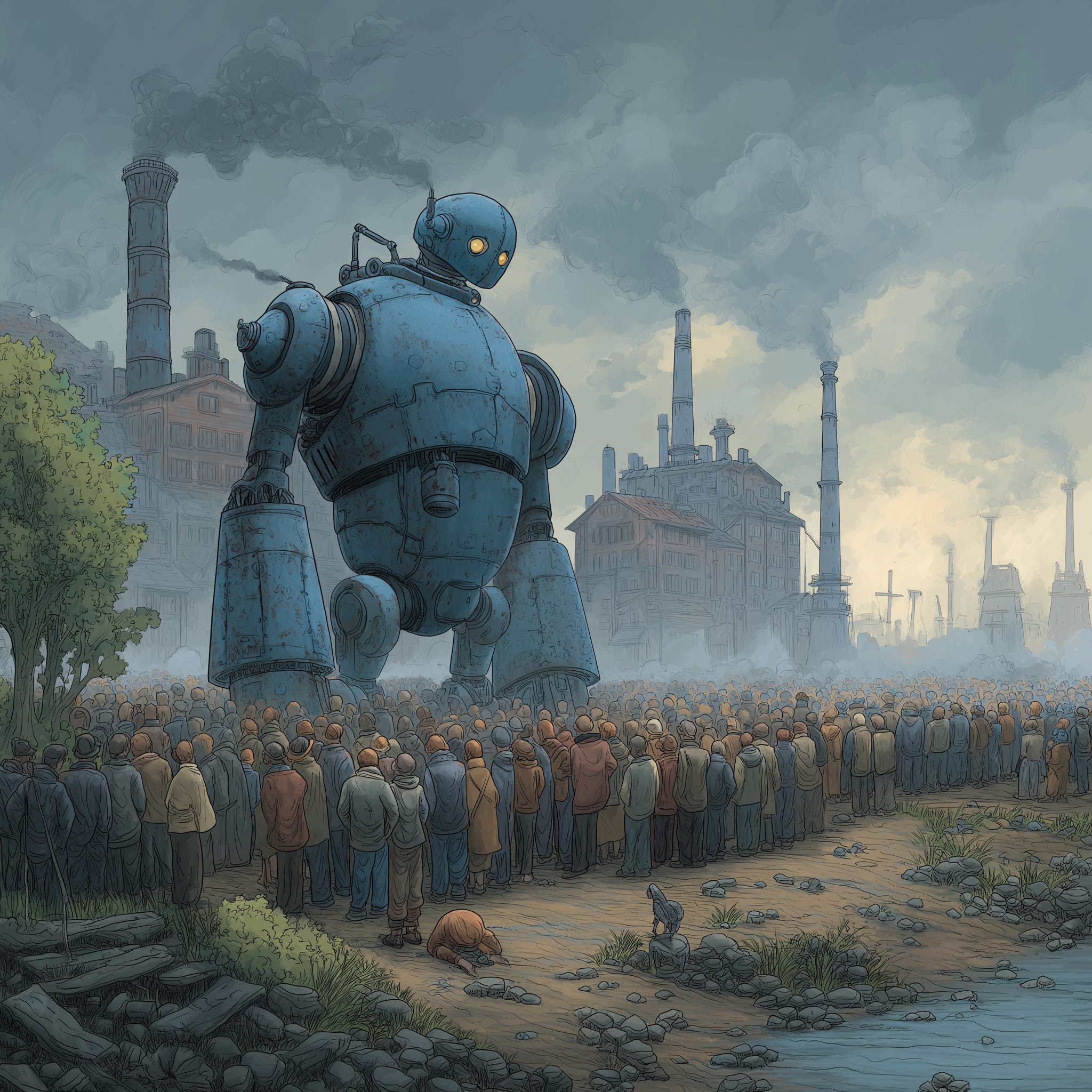
The mad rush to adopt AI has become a suicide spiral where firms are stampeded into retrenching vast numbers of human employees faster than they can find new work, so contracting consumer demand for everything. The paradoxical result: a more productive economy with far fewer consumers.
That’s the warning sounded by US economists Brett Falk and Gerry Tsoukalas in what is not a theory, but rather a mathematical proof that “firms automate their way to boundless productivity and zero demand.” Worse, they add, there is almost nothing that can be done to stop it, short of a heavy tax on all AI whenever it replaces a human. Roughly 80% of all jobs are susceptible to automation, they caution.
“Even as AI-driven layoffs sweep across industries, and even as every firm recognizes that vanishing paychecks mean vanishing customers, not one of them will stop,” the scholars say. Fear of their competitors snatching an AI advantage drives them all down the same path of self-destruction by loss of business.
At the same time AI has other grave shortcomings which are only now becoming plain. The data centres that power it are massive guzzlers of both electricity and water, depleting these vital resources and driving up utility bills for citizens in the communities where they are based. Currently AI uses about 2% of all global power, but this is forecast to double within 5 years.
Furthermore, by taking over basic tasks like reading, writing, drawing and calculating, AI makes the already lazy and stupid even more so by reducing individual brain activity by more than half. In a world where human IQ is already in serious decline thanks to toxic chemicals, AI is helping to build a dumber, more gullible race. The outcome is well-known to psychology: increased dependency, more crime and the replacement of democracy with autocracy.
Artificial intelligence may thus be seen, in reality, to be artificial stupidity – a poison to the human brain as potent as the chemicals and plastics with which it is now saturated.
The deep irony here is that the mistake humans are making with AI they have also made, over and over again, during the past 5000 years, without ever learning from it. For want of a better term, let us call the process technicide – the death of a society that has become excessively infatuated with, and dependent on, a technology.
The earliest civilisations, in the Tigris-Euphrates valley, destroyed themselves through overdependence on irrigation to supply their food. This depleted and salinized the soil so it could no longer support agriculture, which then could no longer support cities.
Modern agriculture is making exactly the same mistake, mechanically destroying billions of tonnes of topsoil a year, consuming 70% of all fresh water, helping to heat the climate to the point where it becomes unfarmable and spreading megatonnes of super poisons.
Fossil fuels, which began life as a boon to human homes and industries in the C19th have now been overused to such a degree they are progressively rendering the entire planet uninhabitable, and are now unlocking other Earth-heating processes that cannot be contained.
Chemistry, also once a boon, has now flooded the world with toxins to such a degree that it is harming all life, deleting human intelligence, fertility, health, development and gender along with most wildlife.
These catastrophes are not the fault of farming, fossil fuels or petrochemistry, which are generally benign when used cautiously. They are the result of colossal overuse, careless misuse and abuse of sound technologies that go bad at scale.
This mistake is being repeated with increased frequency the higher humans climb on the technological ladder. As Brett and Tsoukalas demonstrate, humans are addicts when it comes to over-adopting new technologies. Our infatuation with the latest technology renders us helpless.
Today, AI is not the only supertechnology out of control. Other potentially disastrous technologies include nanochemistry, ‘intelligent’ nuclear weaponry, the creation of new viruses, plastics and universal surveillance.
The fact that the Earth is now carrying four times more humans than it can sustain in the long run means that almost every new technology will be overused to the point where it begins to damage and destroy the Earth system itself.
At present this issue is being addressed by each one of 197 different countries drawing up its own laws and regulations to control the adverse impacts of technological misuse and abuse for each individual technology, one at a time. This means that the problem will never be solved by regulation, as governments are easily corrupted by global corporations promoting their own interests, and there will always be ‘safe havens’ for technologies deemed too dangerous by civilised societies. Furthermore, trying to curb the ill effects of one technology at a time is futile, as new technologies are emerging all the time.
The time to control any technology, for human and planetary safety, is before it begins to inflict harm on both. For this reason it is necessary to assess and regulate all technologies, universally – not one at a time and country by country.
In How to Fix a Broken Planet I proposed that a Global Technology Convention be established to properly assess the risks of all new technologies and recommend remedial action – before they start killing people and damaging the Earth system we depend on for life.
Other essential measures include:
1. A strict code of ethics for all scientific research, imposed independently, to ensure the potential for harm is minimised.
2. A ‘Hippocratic Oath’ for all scientists, as with doctors, pledging them not to develop technologies that may kill or harm humans.
3. New human rights:
a. Prohibiting the mass surveillance of all humanity by governments or corporates.
b. Banning toxic pollution of humans, our food, water and environment with nanoparticles, plastics, forever chemicals etc.
c. A ban on the engineering of deadly new lifeforms.
d. A ban on all killer robots.
While new human rights may not outlaw risky technologies, they set a universally visible standard which all nations and corporations are under public pressure to comply with, and which may give those harmed some legal recourse.
It is time for an overpopulated humanity to understand that the mere adoption of a powerful new technology invariably carries unwanted side-effects and consequences – and that these can be avoided or minimised if all technology is regulated in a similar manner, according to accepted global standards. A global approach is necessary to remediate a global threat.
Great stuff. I would add limiting teacher and student use of AI in schools and universities. We are already at the point at universities where students can use AI for writing and coding, and staff can grade it with AI. Humans are optional. It’s just two groups of computers talking to each other. Where is the learning in that? I just hope my doctor wasn’t taught at an AI university!
Succinct and excellent. Covers the lunacy of efficiency replacing workers and tanking the consumption economy, ultimately unsustainable anyhow. AI and Iran greatly expedite collapse, and the energy and water use are deadly. The competition with agriculture with farm bankruptcies already soaring are going to create famine at a scale never seen before.