
Tackling the Earth Emergency
Precis of address to the Real Truth About Health Conference, 2025

The Great Crisis
We are living through the greatest crisis in humanity’s million-year history, the Earth Emergency.
It’s a converging catastrophe created by humanity’s relentless exploitation of our planet’s finite resources, natural systems and resilience.
Yet no government or global organisation has a plan to address it or arrest the compounding damage.
Science worldwide warns us we are hurtling towards disaster, driven by ten interconnected mega-threats.
These have four main drivers: overpopulation, overconsumption, overpollution and money.
Switching off life support
We are extinguishing Earth’s life support systems.
Three quarters of large wild animals are already gone. So are most birds, fish, reptiles and frogs.
Humans and our livestock now make up 96% of land vertebrate mass.
We are transforming forests into deserts and oceans into dead zones.
Every year, in just seven months human consumption surpasses what the Earth can renew.
We extract 120 billion tonnes of materials annually, destroying soils, water and wildlife along the way.
Freshwater shortages now affect over half the world’s population.
Poisoning everything
We are poisoning everything, especially our children.
Human chemical emissions exceed 220 billion tonnes a year, five times larger than our climate emissions.
They kill 14 million people annually and rob humanity of 600 million years of healthy life. This is the largest act of mass homicide in human history.
Neurotoxins are linked to a 13 point loss in human intelligence since 1975.
Arming for annihilation
The world spends $2.5 trillion a year on new weapons.
12,000 nuclear warheads threaten all life. Even a small nuclear war would kill 2-3 billion people, most by starvation.
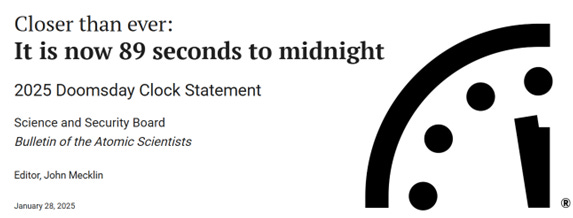
The Doomsday Clock is at 89 seconds to midnight, the closest we’ve ever been to annihilation.
Climate breakdown
Despite pledges, global heating emissions continue to rise.
The world is on track for +2°C by 2050 and +4°C by 2100, conditions under which most food supplies will fail and most human societies collapse.
Methane from melting permafrost, ocean floors and tropical wetlands is already venting, meaning the Earth is now heating itself - and humans cannot stop it.
Runaway technologies
We are unleashing a swarm of dangerous new technologies — AI, biotech, global surveillance, nanopollution, — with no oversight, regulation, or public control. Billionaire ‘tech bros’ are out of control.
Like fossil fuels before them, these tools can inflict global harm, even extinction, if misused or left unregulated.
A breaking food system
Our food system wastes nearly half of what it produces, while destroying the very soils, water, ecology and climate it depends on. It is not sustainable.
It must urgently be replaced by renewable food that recycles nutrients and water, uses far less land and is climate-proof.
The human tsunami
The human population has tripled in a single human lifetime.
Each year, 70 million more people are added to a planet already strained to breaking point.
Mass migration could reach over a billion people per year as climate, conflict, scarcity and sea level rise displace entire populations.
Pandemics are man-made
All pandemics are man-made: they mainly result from overpopulation, overcrowding, ecosystem collapse, global travel, misinformation and bad science.
Since 2000, we’ve seen nine pandemics, with more on the way.
Rogue scientists continue to create deadly new viruses without oversight.
WHO warns the next pandemic could be worse than COVID-19.
A deluge of lies
Lies are now a multi-billion dollar global industry.
The fossil fuel sector pioneered paid disinformation. Politicians, media and other corporates have seized on it.
Misinformation poisons public discourse, cripples democracy, and blocks action when it's most urgently needed.
Solutions exist
All these megathreats are connected and must be solved together, not one at a time. That way lies disaster.
In How to Fix a Broken Planet, I show that global action is not only necessary, but possible.
Transformative solutions
Earth System Treaty — A global compact to address all ten threats together and live within planetary boundaries.
Ban on Nuclear Weapons — A world without nukes is essential for survival.
End Fossil Fuels — To halt climate collapse and stop poisoning ourselves.
Circular Economy — One that recycles everything and shifts to idea-based value.
Renewable Food Systems — Regenerative farms, urban agriculture, and deep ocean aquaculture.
Stewards of the Earth Plan — Rewild half the planet with Indigenous leadership.
Global Clean-Up Initiative — And a new Human Right: the Right Not to Be Poisoned.
World Population Plan — Voluntary family planning and global access to reproductive care.
Pandemic Prevention Strategy — Behavioural reform, bioethics, and early detection.
Technology Convention — A global oversight body for AI, biotech, and beyond.
World Truth Commission — To fight lies with facts, and hold the deceivers accountable.
Earth Standard Currency — An economy rooted in planetary health, not fantasy finance.
Where action begins
Many more solutions are listed in How to Fix a Broken Planet.
But above all, if humans want to survive, we must first agree to survive. This can begin with a new global compact — an Earth System Treaty, committing all of humanity to work together for to a safe, habitable world.
The key to survival is wisdom — the ability to see what’s coming and act in time.
Governments are failing us. So now, the responsibility passes to us all.
A noble cause
By 2030, nearly everyone on Earth will be online.
For the first time in history, we can think together, exchange knowledge and solutions and act with shared purpose.
Uniting to saving a habitable Earth for our children is the greatest challenge — and the noblest cause — in human history.
Row Together — Or Sink Together
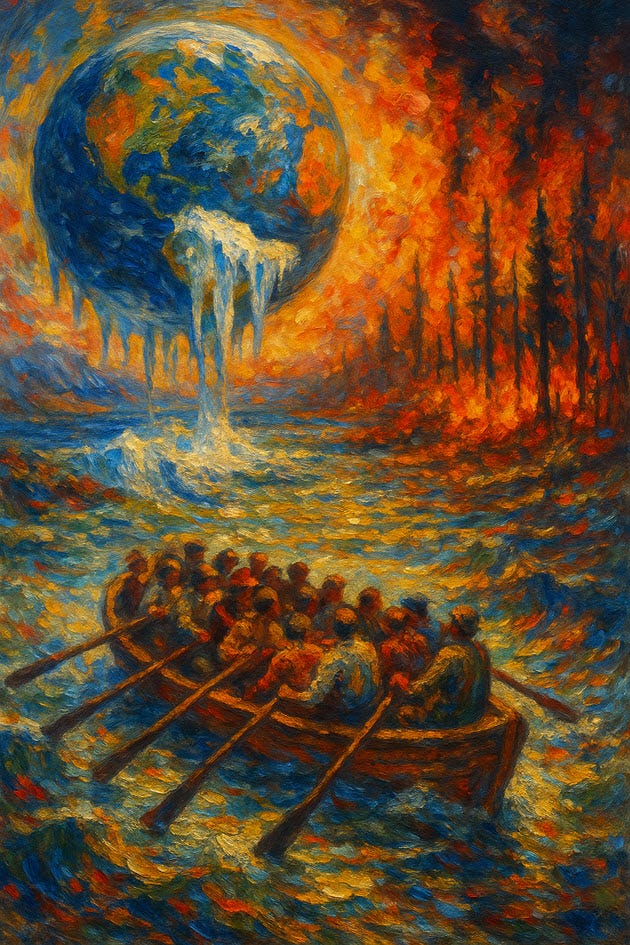
Earth is our lifeboat. It is overcrowded, leaking and under stress.
We either row it to safety, together.
Or we go down, together.
The choice is ours.
Postscript: books by Julian Cribb on the Earth emergency:
How to Fix a Broken Planet: Advice for Surviving the 21st Century
Earth Detox: How and Why we Must Clean Up Our Planet
Food or War
Surviving the 21st Century: Humanity's Ten Great Challenges and How We Can Overcome Them
Poisoned Planet: How Constant Exposure to Man-made Chemicals is Putting Your Life at Risk
The Coming Famine: The Global Food Crisis and What We Can Do to Avoid It
Yes - there do exist as you've said,"...10 interconnected mega-threats". What connects them all is that they are all symptoms of extreme human ecological overshoot. In the science of ecology the term is uncontroversial as it applies to the population dynamics of species in 'nature'. However, the world of people doesn't like this term being applied to humans because we want to believe we can be separate from these laws - we can't.
Regarding only a few of these 'mega-threat' symptoms, our climate is accelerating at a rate that eclipses the Permian-Triassic mass-extinction my multiple orders of magnitude. The collapse of ecosystems that can't adapt to the unprecedented climate change, suffer cascading catastrophic biodiversity loss and extinction, pruning the tree-of-life back to a bloody stump. Meanwhile, the stuff humans have engineered, (which volume currently exceeds the living biomass), continues to break-down into novel-entities which are already is destroying reproductive capacity across the world. #TheEnd
The trouble with your assessment is that it is reductionistic in nature. The predicament we face is ecological overshoot, and it causes all the symptom predicaments you highlighted. Notice that I called them "predicaments." Predicaments have outcomes, not solutions. The best that can be achieved is a reduction of severity.